
|
  |
|
|
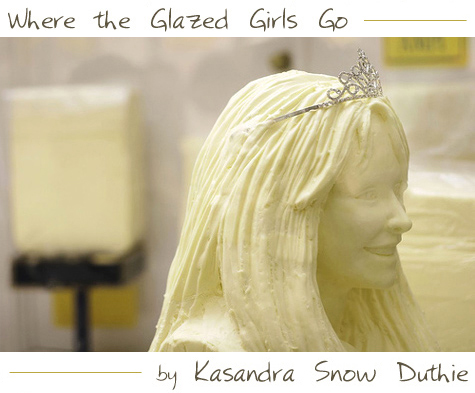
After the butter princess wins her title, the other glazed girls who were sculpted and born from a ninety-pound block leave the fairgrounds too. They go to foster care. Butter flows slower than blood. When you eye butter-flesh closely, you can see its transparency. Faint ripples of mustard seed pollinate her shape as a butter girl walks.
Glazed specimens, dollop-breasts, shiny teeth, and grins as wide as the sky, are softer and less protected than regular Minnesota girls. They're odd. These girls will begin a sentence melodically, the way a harpist plays, but as the thought continues, their tone turns deep—the sound a ewe makes when hustling her lamb close, from a hum inside her throat. A glazed girl is the sadness a country songwriter laughs about before he weeps. I know the way dairy girls act. I know both sorts. I've lived among the real girls, and I was a friend of a glazed girl named Wyn who died. The state fair is the ultimate gathering place for us farm kids. We come from families who teach us to control a heifer with a stick before we can read. Unlike us, the glazed girl is fragile and weak, her soul and body parts born piece by piece from a chisel. Each year, the real dairy princess poses to be sculpted from butter in a temperature-controlled observation room, tiara on her head, parka worn over her pink dress. Created to look like the fair's real dairy princesses, the ruined butter copies fail. When a glazed girl forms, something goes wrong in her enzyme construction. Her DNA is not like our own. She has bad genes and runny chemical compounds. Heartless want grows this cold block of butter into a damaged waif whenever a Frankenstein sculptor works her business. Then, when she arrives, the curdled baby girl rises from a hideous dark place, crying all feral and sheepish, and singing. And if she sings long enough to survive, the glazed baby immediately becomes a yellow pad of gypsy waste to us all. The first time I saw a glazed girl I shunned her because I had learned the butters were known to be diseased and violent. That day, my friends and I had been playing underneath a mailbox on a dirt road. The tiny yellow Vaseline-faced girl walked over and poked a stick at the ants we'd corralled in our fortress of dirt. We shunned her for a while, saying get out of here and go. We said your momma is dead. We said we're going home to eat cake and play with all our money and dolls. We told the glazed girl she was unwanted, but we saw in her eyes she'd already known that her whole life. It made us sad for a minute, so we buried all the ants we'd gathered until they smothered underneath our shoes.
"Hey," I said. "I would never think to make a snack shack out of plaster. What are those little oblong things?" Poking her short yellow finger on the table, Wyn dabbed up plaster shavings and debris. She wore her hair back the way those Robert Palmer girls did in the music video, a sleek, sleek ponytail. Hair the color of a chicken foot. Wyn covered her sculpture in burlap, and looked at me the way a goat spies a person in the distance with one eye—still and frozen, but aware. "I saw your ugly, manure sculpture. No help for it. And, I must say, your stupid friends suck a lot of wang." "Not too much," I said. Then I thought about my allegiances and muttered, "No, they don't even suck wang at all." "Mmm," Wyn grunted, rubbing grit off her fingers. She glowered at her burlap-covered shack. "This is no snack shack. It's a buttered corn stand. Those things you pointed at are not oblongs. They're wine coolers." After that, Wyn took leave from Ms. Feroy's class for a week. We moved on to coil pots, prepping them with glaze for the fire. When Wyn came back, she smelled like canned pumpkin, and her gold lion eyes sat deeper in her yellow face. I asked her where she'd been and she said, "Milking. It's in my blood." I didn't know what she meant, but when I started to ask again, she walked away. "Feroy," Wyn said, clomping toward the art room boom box. "Play that Charlie Daniels Band." Ms. Feroy said she wasn't familiar with Charlie Daniels. "Sure you are, Feroy," Wyn said. "It's that fast fiddle song about the devil the carnies play when you walk past the Zipper ride. At the fair." People laughed. Wyn didn't care. Once fired, my clay pot turned the color of an old soggy tube-sock. After the kiln, Wyn's vase reflected mirrors of moving halo light the way her skin often did. She kept to herself after the class critique when nobody would admit to admiring her art even though it was masterful. Ms. Feroy said that Wyn should pursue her talent as a sculptor. Wyn shrugged, telling Ms. Feroy that she wanted to become a 4-H leader and a County Extension officer instead. "County Extension officers know about the land," Wyn said. "Art is a dream I won't have time for." The next week our class started to work on clay busts. Ms. Feroy asked each of us to choose an inspirational person to be our muse. I selected my friend Becky Norwick because she was sexually active; this made her street-wise and great. Most of the boys chose guitarists or sports stars. Wyn asked Ms. Feroy if she could use someone she had never met. We sculpted our busts for a week before we revealed them to the class for critique. My finished bust looked unromantically fat, and noseless and chinless, instead of loved and voluptuous. Wyn had formed a giant fried pickle on a stick, a face frozen in a murderous scream.
These were lies, of course. High school girls tell lies. They use what they know to invent fear and shameful things they won't understand until they grow old. Or they tell a convincing modern day folk story about a pied piper and his rats. Only this time, the piper is the town hockey hero named Sven, who drives a rusty Ford Bronco. The girls follow him around. They belong to his thick hands. They become entranced and lean into his wintergreen, chewing tobacco breath. They lie about how magical he is. Or, for example, a girl tells her friends something quite stupid. They believe her. Now, why, for instance, does a girl invent a psychotic dwarf she once saw masturbating on an old mattress in her neighbor's basement? She invents this story because she likes being afraid of old pipes and darkness. She likes the idea of fear and suffering, but only hypothetically. After Wyn sculpted the creepy pickle face on a stick, I had no choice but to ignore her forever. She had opened some freaky fear in that pickle face, displaying it proudly to the high school world. My friends and I only spoke of the heinous and wicked when we could invent ways to pass judgment on others. This was something we saw our mothers do. Our mothers weren't gossips. No, they were actually just shedding light on what was already common knowledge. We teens hadn't yet honed our mothers' subtle talk-of-the-town skills. We sought drama. Our teenage pain and confusion became what we said we saw in people like Wyn. My friends and I drenched each other with stories about shaken babies and orphan glazed girls without identities. After the term ended, I didn't see Wyn very often. She started dating a guy who sported a thin moustache and wore big black boots. People said he gave Wyn crabs, and then they forgot about Wyn entirely. The guy didn't go to our school. He looked old and singed, way too heavy metal. Sometimes Wyn and I would nod at one another when we passed in the hall. That was about it. During the winter, Wyn walked to the old guy's Chevy pickup near where the smokers stood when they could stand the cold long enough to smoke. Even in winter, she wore nothing more than a jean jacket or one of those windbreakers with all the useless zippers. I never understood how her gaunt yellow body could stand the cold and wind. It was as though Wyn lived to be bravely frozen and oblivious, standing around smiling in the gray brutal tundra of our winters. About a year after art class ended, I met Wyn's mother while I shopped with mine at the dime store. They knew each other through church group. Wyn had never lived in foster care. She had been adopted as a three-day-old butter baby by this woman named Carma. Wyn's adoptive father was named Jim. The Gustafsons worked as accountants in the strip mall in an office they shared. When my mom introduced me that day, I told Wyn's mother I thought her daughter was a good artist. But when Carma left my mother and me, I whispered that Wyn was having sex with a pedophile dope-dealer.
Posthumous Wyn reminded us girls of driving around in some old car. You look down to the left and there's this black raggedy scar running through the driver side mirror. Our own cracked faces reflect our distortion, allowing space, and trees, and somebody passing behind us. I remember so many people saying Wyn was the funniest glazed girl. As if they knew a multitude of butter girls. I remember someone saying how they once parked in the woods with Wyn, and drank blueberry milkshakes and talked about the stars. After her death, Wyn's short life became famous because we wanted a new fable. Everyone knew her suddenly. Ha ha ha, we said, I remember Wyn doing the Hustle in a barn loft, her hair matching the color of the hay. Wyn was a borrowed child; her adoptive mother told me this years after she died. I saw her mother in the grocery, and I confessed I hadn't been close to Wyn. But she sure did march to her own drum, I said. I smiled the stupid way you do when you know you should stop talking. Wyn's mom looked off toward the dairy aisle. "We adopted her when she was tiny," she said. "But you know, even when Wyn was very young, she was reckless." Then Carma's face puckered. She looked at me as if prescribing some sentence or judgment. "We were aware of it," she said, wringing her hands on the grocery cart.
Copyright © Kasandra Snow Duthie 2008. |
|
 |
|
 |
